


The long arm of the library has made a writer of me. This long arm, a composite of many libraries, created the conditions through which a shy reader could continue to live in her head.
I was born and raised in India. It is a country of daily wage earners in makeshift dwellings trying to survive alongside the world鈥檚 richest individuals ensconced in immovable towers. It is also a country where the practice of circulating knowledge through libraries has a long history.
It ranges from the library at founded in 427CE, over a thousand years before the Bodleian at Oxford, to , who takes books to villagers in rural Kerala. And from nine-year-old Muskan, who started her own library for kids in the slums of Bhopal, to Kavita Saini from Rajasthan, who opened a library for girls not allowed to leave their village.
This tradition of sharing knowledge held in written texts is bound up with aspiration, pleasure and survival.
Borrowed words as toys
For many years, my mother worked at Glaxo Laboratories in Mumbai. Along with tins of the nutrition drink Complan, she also brought home a variety of borrowed books and magazines from what we think was called the 鈥淕laxo Workers Sports Library鈥�.
The privilege of access to such a workplace lending library ensured that, in the safety and comfort of my home, I could read with great pleasure: Enid Blyton, The Adventures of Tintin, and magazines, .
Along with mum鈥檚 鈥渙ffice鈥� books with their flap on the first page marking the names of borrowers and the dates of their borrowing, we had access to books from , a circulating library in the tallest apartment complex in our area. It was a storehouse of Archie comics and the Amar Chitra Katha series, Indian mythology told through comics.
Our apartment block had its own circulating library, where I sometimes volunteered so that I could read , a luscious interior design publication edited by Naomi Menezes and Mallika Sarabhai, two women ahead of their time.
The words in these books and magazines turned into imaginative wanderings on the page in my school assignments, where I played with these words as if with new toys: amateur, legionnaire, blistering barnacles.
Later, as an undergraduate at St Xavier鈥檚, Mumbai, among the rows of books and journals stacked on metal racks and wooden shelves in the Lending Library, a space anchored by Dewey Decimals, soaring with Shakespeare, Austen, and , I began my internship, although I didn鈥檛 know it then.
Up a few flights of wood and stone steps, in the Reference Library, amid card catalogues in ornate wooden cabinets, I read, I reflected, I wrote notes on lined paper, surrounded by the stability of oak, the hardiness of teak, and the words of the outside world waiting to be incorporated.
From the British Council Library and the US Information Services Library, there were books borrowed and carted home on crowded Mumbai trains, some read, some unread, most returned on time: Charles Dickens, , .
The work of writing begins with attention to acts of generosity and care: the writer gifting their imaginative labour to the writer-in-waiting, who is always a reader, often with the library enabling this exchange. It continues as one is startled by another writer鈥檚 fresh use of language, as one yields to the surprise of fictive worlds. Amid this slow but sure transmission of knowledge, through the pleasure of reading, a writer is undone and made anew.
In Sydney, burdened with an empty wallet, surrounded by plane trees and citizenship ceremonies, I settled into the arms of the free council-run libraries, in Chatswood, Ashfield, Campsie, Earlwood and Marrickville, then in Springwood and Katoomba, and the library at the University of New South Wales, my natural homes.
In these places I encountered clarity and conviction in the words of others, clich茅s stopped in their tracks, expectations subverted and made beautiful on the page: , , , , , , , and .
Reading rare materials 鈥榖ecause I asked鈥�
Eventually I came to the Mitchell Library Reading Room at the State Library of NSW, where I could knock, seek, ask for or a 1792 edition of Mary Wollstonecraft鈥檚 or the journals of Governor Lachlan Macquarie and they would be given unto me.
In Edinburgh, in the Special Collections Reading Room of the National Library of Scotland, overlooking a city of stone and sagacious light, I asked for and received a 200-year-old diary, its paper like linen, the handwriting within it like trees of rowan and beech bending to the wind.
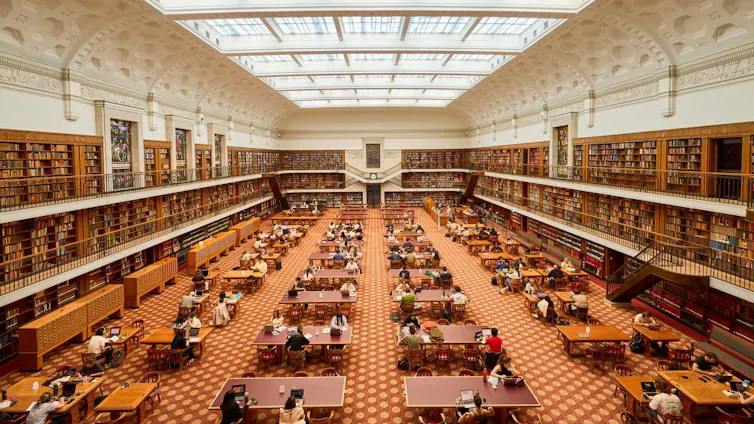
This and other rare materials were lent to me, a woman from the other side of the world, simply because I asked. Weights of different shapes and sizes were provided to protect the material, guidance offered, all my questions answered. Yet again, I was a beneficiary of the long arm of the library reaching out with a commitment to the sharing of knowledge through responsible custodianship.
In March 2024, in the state of Uttar Pradesh in northern India, approximately 427 kilometres from Nalanda University, a an eight-year-old girl running away as a politician鈥檚 bulldozers were demolishing her makeshift dwelling. Unlike me, she was growing up without a safe and comfortable home.
As she ran for her life, she carried in her arms only the essentials for survival: not money nor food nor clothing but the things that mattered most, her books, her own little library 鈥� its long arms protecting her and being protected by her; hopefully, inevitably making her anew.
This is an extract from , edited by Richard Neville and Phillipa McGuinness, published by NewSouth Publishing in partnership with the State Library of NSW.
, Senior Lecturer in Creative Writing,
This article is republished from under a Creative Commons license. Read the .


