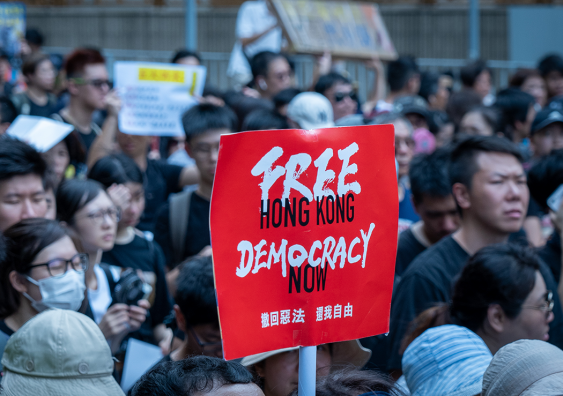
This week, after a 156-day trial, the Hong Kong pro-democracy campaigner and media tycoon Jimmy Lai was of sedition and collusion with foreign or external forces.
Now facing life in prison, Lai was convicted under the country鈥檚 , introduced in 2020.
During the 2019 protests in Hong Kong, Lai and the media outlet he owned 鈥� Apple Daily 鈥� regularly presented the views of pro-democracy activists.
It openly criticised the Hong Kong and Beijing governments, and encouraged readers to participate in pro-democracy rallies and protests.
Apple Daily and Lai came to symbolise the democratic ideal of a free press, able to criticise those in power without fear of censorship or sanction.
His conviction represents a major blow to those ideals.
The end of press freedom in Hong Kong?
In the years since the introduction of Hong Kong鈥檚 National Security Law, press freedom has slowly been limited. Lai鈥檚 conviction symbolises it has now ended altogether.
In 2002, Hong Kong was ranked globally for press freedom in the Reporters Without Borders Press Freedom Index. It fell to 39th in 2005, and then to in 2019.
After the introduction of the national security law in 2020, a soon took hold. Many pro-democracy media outlets and NGOs quickly disbanded.
This included and Hong Kong鈥檚 last opposition party, the .
Hong Kong has now plummeted to in the world press freedom rankings. Press freedom conditions are 鈥渂ad鈥� or 鈥渧ery serious鈥�, according to Reporters Without Borders.
However, Lai鈥檚 trial symbolises a shift from self-censorship to an official view that certain media outlets are illegal.
It comes across as a clear message from the government that dissenting views will not be tolerated.
The Hong Kong media no longer serves as a vehicle for alternative views and airing of different political positions.
From rule of law to ruled by law
In the common law tradition, it is not uncommon for legislation to contain some degree of ambiguity. This is so courts can consider the 鈥渟pirit鈥� or 鈥減urpose鈥� of the law as they pertain to each unique case. It allows flexibility as circumstances change.
In the 2020 National Security Law, however, what counts as violating national security is left completely undefined. This means could be construed as violating national security.
In July 2022, the United Nations Human Rights Committee raised about this law and the lack of clarity around the definition of 鈥渘ational security鈥�.
This ambiguity means Hong Kongers are left in a state of uncertainty over which activities will or will not be perceived as undermining Beijing鈥檚 political authority.
Lai鈥檚 conviction (along with the conviction of ) signifies that one possible definition of 鈥渘ational security鈥� could be anything against Beijing鈥檚 agenda.
A blow to public trust in the courts
Lai鈥檚 conviction also represents a significant blow to public trust in Hong Kong鈥檚 judicial system.
In Hong Kong, judicial independence is constitutionally described in what鈥檚 known as the . Various articles of this law mention that:
- Hong Kong courts are independent and free from interference
- members of the judiciary shall be immune from legal action in the performance of their judicial functions
- judges shall be appointed by the chief executive based on the recommendation of an independent commission composed of local judges, persons from the legal profession and eminent persons from other sectors.
In reality, however, problems soon become apparent.
The Bar Human Rights Committee 鈥� an independent, international human rights arm of the bar of England and Wales 鈥� has flagged regarding the lack of transparency about how cases are assigned within the Hong Kong judiciary.
Tribunal procedures are also separate for national security cases, which are presided over by a designated panel of judges. These judges are selected by the chief executive in consultation with the politically appointed National Security Committee.
Surveys show a significant drop in Hong Kong citizens鈥� perceptions of the fairness of the judicial system, the impartiality of the courts, and the rule of law. This drop has been observed since the introduction of the National Security Law in 2020.
Lai鈥檚 trial symbolises that the public trust and confidence in Hong Kong鈥檚 courts no longer exists. In fact, one of the main slogans in support of Lai on social media is 鈥溾��
The end of 鈥榦ne country, two systems鈥�?
Lai鈥檚 conviction represents a failed attempt to challenge the Chinese political regime.
It shows any action that may be perceived as interfering with the legitimacy of the Chinese government could be deemed as 鈥渋llegal鈥� and in violation of 鈥渘ational security鈥�.
, Senior Lecturer of Sociology and Social Policy,
This article is republished from under a Creative Commons license. Read the .